





.png?width=1920&height=1080&name=Consulting2_Menu_1%20(1).png)







Article
Navigating the new Healthcare highway: Change Management
at the wheel

Dominique Green
VP, Citius Healthcare Consulting

08-Jan-2026

Share:
Change management is not just a support function – it is a strategic accelerator. Organizations that embrace change agility outperform peers in growth and innovation, achieving significantly higher ROI and stronger outcomes. Yet despite these undeniable benefits, many leaders still hesitate to invest in the very fuel that powers transformation. This raises an important question: why do buy-ins stall when the case for change enablement is so strong?
Why change management hits a red light?
If positive outcomes are so inextricably tied to strong change programs, why does executive buy-in so often stall at the starting line?
AI, digital health, and telemedicine, Cybersecurity, revenue cycle, and value-based care all get the green light. But when it comes to change management, the signal flips to a hard STOP.
Does the idea of investing in people not sound as visionary? Is a strategy built on empathy, trust, communication, and engagement too abstract for some logic-driven, data-preferred, left-brain thinkers?
Is an investment in people seen as too ‘soft’ - a nice-to-have, and a detour from what some consider ‘real’ innovation?
The truth is, most (70%) leaders veer off course not because of poor vision, but because they underfund the change management fuel needed to reach their goals. That number hasn’t changed much over the past couple of decades. And yet, many still drive forward with blinders on – well-intentioned, but with plans disembodied from the very humans who could make them meaningful possibilities.
AI. Are we there yet?
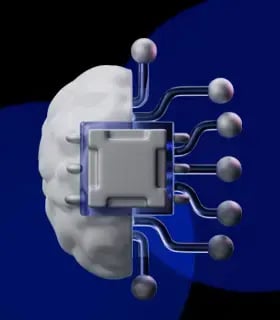
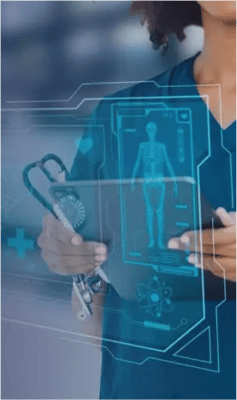
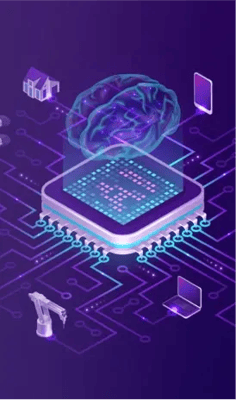
Organizations are eagerly investing in AI solutions. Healthcare AI spending hit $1.4 billion this year, nearly tripling 2024’s investment.[3] The efficiency of today’s favorite strategic initiative is indisputably smart. Our machine-learning, data-mining, trend-spotting, image-recognizing, remote-monitoring, chatbot companion is not just along for the ride – it’s helping us navigate the road ahead.
Change leaders understand that while AI is advanced and undeniably futuristic, it’s still experimental by nature. It can’t drive solo. Its full potential depends on human copilots - those who bring contextual awareness, emotional intelligence, and abstract thinking that go far beyond AI’s technical reach.
So, as we accelerate into the future, the question remains: Who should be in the driver’s seat?
Fork in the road: Artificial Intelligence or Authentic Intelligence
To truly unlock the power of AI, organizations must also invest in their human resources. Like any well-planned road trip, the journey requires more than a powerful engine – it needs a reliable GPS. That’s where change management comes in.
What strong change management programs do
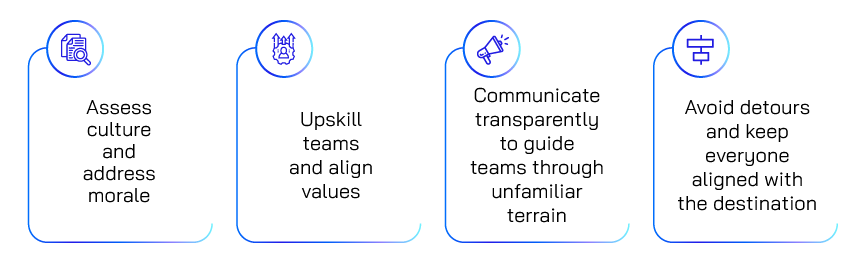
Leaders who prioritize their teams – their authentic intelligence – gain advantages that AI alone can’t deliver:
- Human creativity, intuition, judgment, and moral reasoning.
- Context to data, empathy in decisions, and innovation in strategy.
As AI becomes more deeply embedded in our workflows, it’s not a question of man versus machine – it’s about collaboration. And as we continue down this road, one thing is clear:
The journey is human-led, AI-assisted, and the destination depends on both.
Under the hood: Building strong change programs
Strong change programs don’t follow a single route. While proven frameworks offer reliable guidance, the terrain often demands custom-built solutions tailored to the unique contours of each client organization. Healthy change programs begin with:
- Data-driven assessments: The dashboard that reveals where attention is needed and how stakeholders are positioned for the road ahead.
- Readiness planning: Whether the plan involves readiness assessments or building enterprise-level change management offices, the destination remains the same: sustainable transformation.
- Empathy and precision: Navigating human behavior with empathy and precision, while leveraging data, tools, and technology to challenge mindsets and accelerate business outcomes.
- Clear communication: Acts as the fuel, bridging the gap between strategic intent and personal relevance – the “what’s in it for me?”
When people see the road ahead and believe they have a role in shaping it, change stops being a mandate and becomes momentum.
Driven by purpose
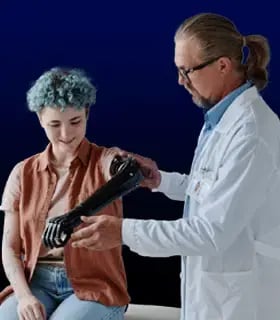
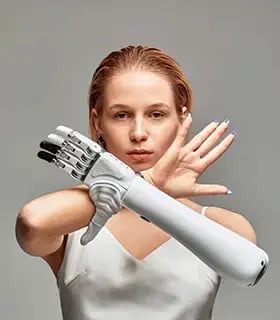
We all want to make good time, but let’s not mistake shortcuts for progress. In healthcare, our shared desire is to help. We build technologies that restore mobility, design systems that expand access to care, and develop innovations that reduce costs and improve health outcomes. These are extraordinary achievements. But beneath every algorithm, every dashboard, and every clinical advancement lies something far more powerful: compassion.
While tools and technologies enable progress, it’s human intention that creates meaning. The desire to heal, to comfort, to improve life for someone else – that’s what fuels real innovation.
The most future-fit healthcare organizations will:
- Invest not only in artificial intelligence, but in authentic human intelligence.
- Build cultures where empathy and analytics evolve together.
- Make change management a strategic imperative, not an afterthought.
When people are empowered to adapt, inspired to lead, and anchored in purpose, they don’t just navigate change, they pave the way. In the end, it’s not the speed at which we travel that matters most – it’s who we bring along, and how deeply we care about where we’re going.
































.webp?width=400&height=400&name=The%20future%20of%20Healthcare%20(1).webp)







.png?width=400&height=400&name=7-Jun-13-2025-02-27-19-6568-PM%20(1).png)


