






.png?width=1920&height=1080&name=Consulting2_Menu_1%20(1).png)







Article
AI is reshaping Healthcare Complaint Management:
Why it matters and how to act

Divya Dixit
AVP, Citius Healthcare Consulting

05-Jan-2026

Share:
Healthcare complaint management spans medical device safety, pharmaceutical pharmacovigilance, and payer-provider systems, each addressing unique yet interconnected challenges. Medical device complaint management ensures product safety, pharmacovigilance monitors adverse drug reactions (ADRs), and payer-provider systems tackle issues related to billing, coverage, and care quality.
The intersection of payer and provider complaints – particularly in claim denials, care coordination, and shared data – creates opportunities for integrated solutions that improve patient experience and operational efficiency.
With complaint volumes and regulatory scrutiny rising sharply, traditional processes are under strain. Generative and Agentic AI can cut resolution times by up to 50%, enhance compliance, and improve patient trust by automating reporting, accelerating signal detection, and orchestrating workflows across domains.
This article explores these processes, their intersections, and the role of AI, and outlines practical steps for organizations to act now.
Understanding the domains
- Complaint Management in Medical Devices
Complaint management in medical devices involves identifying, documenting, and resolving issues related to device performance, safety, or usability – a process critical for product safety and regulatory compliance.
Regulatory bodies like the FDA and EMA enforce standards such as Medical Device Reporting (MDR) and ISO 13485, making timely and accurate reporting essential. The process typically involves several core activities:
- Data collection: Gathering feedback from users, providers, or internal testing
- Analysis: Investigating root causes of device failures or adverse events
- Regulatory reporting: Submitting timely reports to regulators
- Correction action: Implementing recalls, design changes, or training
However, organizations face significant challenges in managing these processes effectively:
- High volumes of unstructured data (e.g., user reports, technical logs)
- Tight reporting timelines
- Cross-functional coordination
- Pharmacovigilance in Pharmaceutical Companies
Pharmacovigilance (PV) focuses on detecting, assessing, and preventing ADRs to ensure drug safety across pre- and post-market phases. Core activities include:
- Adverse event reporting: Processing Individual Case Safety Reports (ICSRs)
- Signal detection: Identifying risk patterns in large datasets
- Regulatory compliance: Adhering to FDA, EMA, and WHO guidelines
- Risk management: Developing mitigation strategies
Key challenges that complicate these efforts include:
- Exponential data growth, e.g., FDA’s Adverse Event Reporting System (FAERS) database grew from a few million reports to approximately 32 million reports by 2025
- Manual processing of reports
- Global regulatory variations
All of these lead to slow response times and heightened compliance risk.
- Complaint Management in Payer Systems
Payers (e.g., insurance companies, Medicare) manage complaints related to financial and coverage aspects of healthcare, including billing disputes, claims denials, and network access issues. Key activities include:
- Complaint types: Claim denials, billing disputes, network access issues, or poor customer service
- Intake: Receiving complaints via call centres, portals, or regulatory bodies like CMS
- Investigation: Reviewing claims, policies, and provider documentation
- Resolution: Adjusting claims, correcting errors, or escalating to appeals
- Reporting: Documenting for compliance with CMS or state insurance laws
Key challenges include:
- High complaint volumes. For example, 1.2 million Medicare complaints in 2022
- Complex policy structures
- Coordination with providers for resolution
- Complaint Management in Provider Systems
Providers (e.g., hospitals, clinics) handle complaints tied to care delivery and patient experience. Key activities include:
- Complaint types: Care quality issues (e.g., misdiagnosis, delays), billing errors, or service complaints (e.g., long wait times, staff behaviour)
- Intake: Collecting feedback via surveys, hotlines, or patient portals
- Investigation: Reviewing medical records, billing, or conducting root cause analysis
- Resolution: Correcting bills, improving protocols, or addressing patient concerns
- Reporting: Tracking for quality improvement and compliance with HIPAA or Joint Commission standards
Challenges include:
- Diverse complaint sources
- Balancing clinical and patient satisfaction priorities
- Overlap with payer-related issues like billing disputes
- Intersection of Payer and Provider Complaint Management
The intersection of payer and provider complaint management is critical, as many complaints span both domains, requiring collaboration or shared processes. Key areas of overlap include:
- Claims denials and billing disputes: A patient may complain to a provider about a bill and to a payer about a denied claim, necessitating joint investigation (e.g., verifying coding accuracy and policy coverage)
- Care coordination issues: Complaints about delays (e.g., procedure approvals) involve payers (authorizing coverage) and providers (scheduling core)
- Shared data and insights: Both use complaint data to identify trends, such as frequent denials or coding errors, which can improve operations if shared
- Patient-centric resolution: Patients expect seamless solutions without being shuffled between parties, as seen in integrated systems like Kaiser Permanente
- Regulatory alignment: Both adhere to HIPAA, but payers face CMS rules, while providers meet clinical standards, creating shared compliance needs for certain complaints (e.g., frauds)
Example: A patient disputes a bill for an out-of-network procedure. The provider investigates service details, while the payer reviews coverage policies. Resolution required data sharing and coordination to clarify the issue and prevent recurrence.
Deeper intersection insights:
- Technology as unifier: Shared platforms (e.g., EHRs integrated with claims systems) could streamline data exchange, reducing resolution times by up to 30%
- Joint accountability: Collaborative teams or protocols could address overlapping complaints, like claim denials tied to provider errors
- Predictive analytics: Analyzing complaint patterns across both domains can pre-empt issues, such as identifying providers with high denial rates
- Patient trust: Unified responses to complaints enhance patient satisfaction, critical for CMS Star Ratings and provider reputations
Broader intersection across all domains
The three domains – medical devices, pharmacovigilance, and payer/provider complaints – share broader intersections:
- Data-driven insights: All rely on analyzing unstructured data (e.g., patient reports, social media, call logs) to detect issues
- Regulatory compliance: Each faces stringent regulations (FDA, EMA, CMS, HIPAA), requiring accurate documentation and reporting
- Timely action: Rapid issue resolution is critical to patient safety and trust
- Cross-functional needs: Coordination among clinician, regulatory, and operational teams is essential
These shared traits make AI a powerful tool for unifying processes across domains, particularly at the payer-provider intersection.
The role of Generative and Agentic AI
Generative AI applicationsGenerative AI, including large language models (LLMs), excels at processing unstructured data and generating actionable outputs. Its applications include:
- Automated reporting: Drafting ICSRs, MDRs, or complaint summaries, reducing processing time by 40-60%.
- Data extraction: Analyzing diverse sources (e.g., EHRs, patient portals, social media) to extract safety signals or complaint details.
- Sentiment analysis: Prioritizing urgent complaints by detecting patient frustration in payer/provider feedback.
- Regulatory documentation: Generating compliant reports for FDA, EMA, CMS, or HIPAA submissions.
Example: A payer leveraged generative AI to summarize billing complaints, cutting manual review time by 50%, while ensuring CMS compliance.
Agentic AI applicationsAgentic AI autonomously executes workflows and makes context-driven decisions, ideal for complex, cross-domain processes. Some of its applications include:
- End-to-end automation: Managing complaint lifecycles, from intake to resolution, across payers, providers, and PV.
- Proactive signal detection: Continuously monitoring datasets to flag risks, such as device failures or claim denial patterns.
- Cross-domain coordination: Aligning payer-provider teams for billing disputes or PV-device teams for adverse event investigations.
- Predictive analytics: Forecasting high-risk areas (e.g., frequent denials or ADRs) to prevent complaints.
Example: An agentic AI system reduced claim denial resolution time by 40% by automatically coordinating data between payers and providers.
Benefits across domains
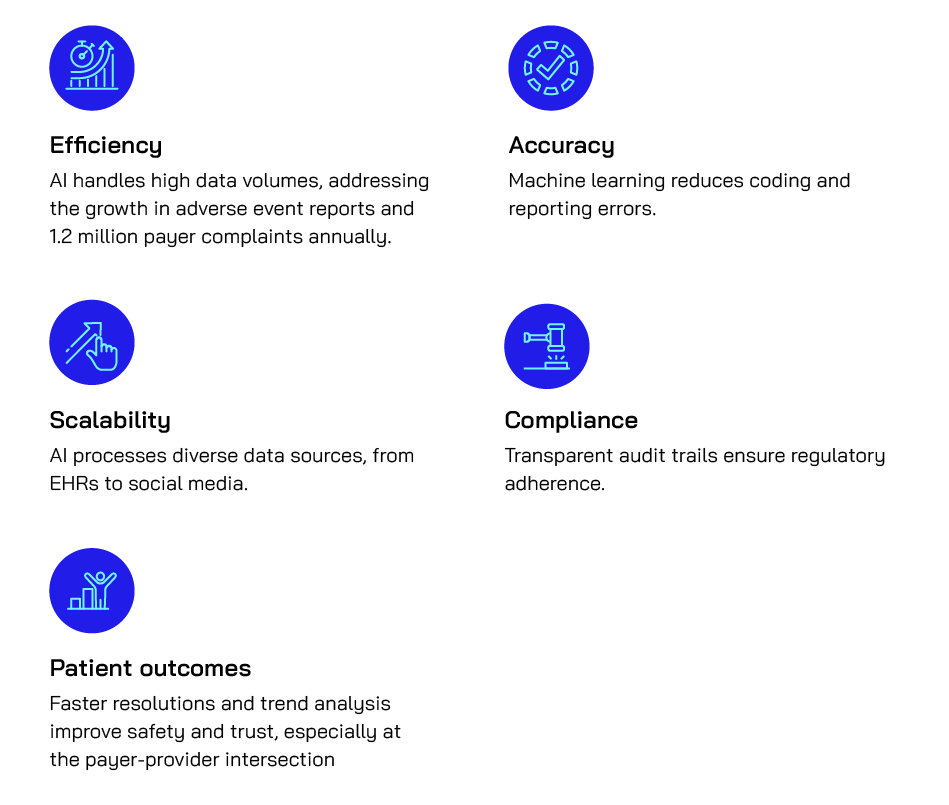
Implementation challenges and solutions
Organizations face several barriers when adopting AI for complaint management and pharmacovigilance:
- Data fragmentation: Siloed data across payers, providers, and manufacturers hinders AI performance.
- Regulatory compliance: Evolving regulations (e.g., EU AI act) demand transparent AI models.
- Bias risks: Non-diverse training data can lead to inequitable outcomes.
- Cybersecurity: Patient data requires robust protection under HIPAA/GDPR.
- Cost and expertise: AI implementation requires significant investment and technical know-how.
To overcome these challenges, organizations should focus on:
- Data integration: Use interoperable platforms (e.g., Salesforce Health Cloud) to unify data access across domains.
- Regulatory alignment: Collaborate with regulators to validate AI models and ensure compliance.
- Bias mitigation: Train AI on diverse datasets and conduct regular audits to maintain fairness.
- Cybersecurity: Implement encryption and audit trails for compliance to safeguard patient data.
- Partnerships: Work with AI vendors and train staff to bridge expertise gaps.
Future outlook
AI will continue to transform complaint management and pharmacovigilance, driving greater integration and efficiency across healthcare domains. Key trends shaping the future include:
- Integrated platforms: Shared AI systems for payers, providers, and manufacturers will streamline data exchange and enable unified complaint resolution.
- Real-time analytics: Continuous learning AI will accelerate signal detection and resolution, reducing risk and improving compliance.
- Patient engagement: AI-powered chatbots and virtual assistants will provide omnichannel complaint intake, enhancing accessibility and responsiveness.
- Global standards: AI-enabled collaboration will support unified safety monitoring across borders, improving regulatory alignment and patient trust.
The payer-provider intersection will benefit from AI-driven coordination, reducing resolution times and boosting patient satisfaction. To capitalize on these trends, organizations need a clear roadmap for AI adoption. Here are some recommendations:
- Leverage hybrid AI: Combine generative AI for data processing with agentic AI for automation, especially for payer-provider coordination.
- Build shared platforms: Invest in interoperable systems to unify payer-provider data.
- Select tools strategically: Choose tools for cross-domain workflows.
- Foster collaboration: Create joint payer-provider teams to address intersecting complaints.
- Monitor performance: Regularly evaluate AI outputs for accuracy, compliance, and fairness.
Conclusion
Complaint management in medical devices, pharmacovigilance, and payer/provider systems shares common goals of safety, compliance, and patient trust. At the intersection of payer and provider complaints – such as claim denial, care coordination, and shared data – there are unique opportunities for integrated AI solutions. Generative and Agentic AI can automate workflows, enhance analytics, and streamline collaboration, particularly in these overlapping areas. To fully leverage these opportunities, healthcare organizations must select appropriate tools and address challenges like data integration and compliance, unlocking greater efficiency and improved outcomes.










































.webp?width=400&height=400&name=The%20future%20of%20Healthcare%20(1).webp)










.png?width=400&height=400&name=7-Jun-13-2025-02-27-19-6568-PM%20(1).png)


